
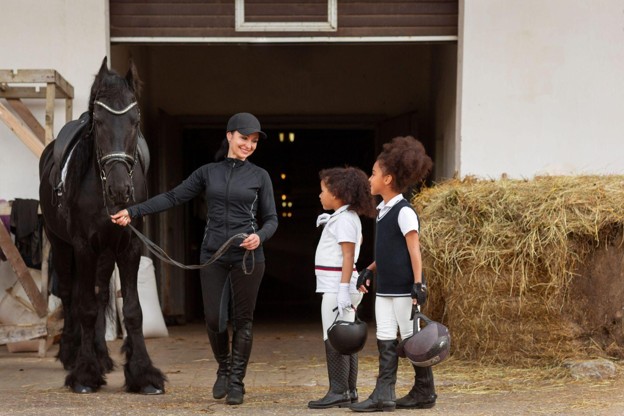
Learning to ride involves much more than developing balance, coordination, and control. Freddie Vasquez Jr emphasizes the importance of another skill that can take years to develop: learning to read a horse. Before a rider can respond effectively, the rider needs to recognize what the horse is communicating through movement, posture, attention, and behavior.
This ability is sometimes described as having a feel for the horse, but it is not simply an instinct that experienced riders are born with. It can be developed through observation, consistency, and time spent understanding how horses communicate.
For newer riders, learning to notice these signals can make riding more productive while also helping establish a stronger relationship between horse and rider.
Horses Communicate Before Riders Ask a Question
A horse does not wait until a rider gives a cue to communicate.
Changes in posture, movement, attention, breathing, and facial expression can provide information about how the horse is experiencing a particular situation.
For example, a horse that becomes tense may be responding to something in its environment. A horse that loses attention may be distracted, uncertain, tired, or simply processing unfamiliar information.
That does not mean every behavior has one universal meaning.
Instead, riders should learn to consider behavior in context.
A useful starting point is to observe:
- Where the horse’s attention is directed
- Whether the horse appears relaxed or tense
- How freely the horse is moving
- Whether its behavior changes in a particular environment
- How it responds to familiar and unfamiliar cues
- Whether a change appears suddenly or gradually
Observation creates information that can guide the rider’s next decision.
Learning the Difference Between Tension and Resistance
One of the most important distinctions for developing riders is understanding that a horse’s difficulty does not automatically mean the horse is being disobedient.
Tension can affect how a horse responds.
A horse may become less responsive when uncertain. It may rush, hesitate, stiffen, or change its rhythm. A rider who interprets every unexpected response as resistance may react by increasing pressure, potentially making the original problem worse.
A more thoughtful response begins with a question:
What might be causing this change?
The answer could involve the environment, the exercise, the rider’s position, unfamiliar surroundings, fatigue, confusion, or another factor. This approach encourages riders to solve problems rather than simply react to them.
Attention Is a Two-Way Conversation
Riders often focus on keeping the horse’s attention. But riders need to maintain their own attention as well. A horse can detect changes in the rider’s balance, tension, rhythm, and consistency. If a rider becomes distracted or nervous, those changes can influence communication.
This is particularly important for beginners because concentration can disappear quickly when a rider is learning a new skill.
A rider may become focused on remembering where to place the hands, how to position the legs, or what comes next in an exercise.
Meanwhile, the horse is providing information that the rider may not notice. Developing awareness means gradually learning to process both sides of the interaction.
The Importance of Rhythm
Rhythm is another useful window into what a horse is experiencing.
A consistent rhythm can indicate that the horse and rider are working together comfortably. A sudden change may provide useful information.
If a horse begins moving faster, slowing down, breaking its rhythm, or becoming inconsistent, the rider should notice the change before immediately trying to correct it.
The change itself is information.
- Perhaps the horse has become distracted.
- Perhaps the rider’s position has changed.
- Perhaps the exercise has become difficult.
- Perhaps something in the environment has captured the horse’s attention.
The goal is not to assume the answer but to recognize that the horse has provided a signal worth investigating.
Body Language Can Reveal Confidence
Confidence is not always obvious.
A horse may appear physically capable of completing an exercise while still feeling uncertain about it.
Learning to recognize subtle changes can help riders understand the difference.
A confident horse may move forward with greater consistency and maintain attention on the task. An uncertain horse may hesitate, become tense, look toward distractions, or alter its movement.
Again, context matters.
The same behavior can have different causes depending on the situation.
This is why learning to read horses requires repeated observation rather than memorizing a list of behaviors and assigning each one a fixed meaning.
New Riders Should Learn to Observe Before Correcting
One of the most useful habits a developing rider can build is pausing mentally before reacting.
If something goes wrong, the immediate instinct may be to correct the horse.
But a moment of observation can reveal more.
- What changed?
- What happened immediately before the change?
- Did the rider alter position?
- Did the environment change?
- Was the exercise more difficult?
- Did the horse lose rhythm?
These questions turn an unexpected moment into a learning opportunity. The rider is no longer simply trying to make the horse do something differently. The rider is trying to understand why the interaction changed.
Good Instruction Makes Observation Easier
Learning to read a horse does not mean that beginners are expected to figure everything out independently.
That is one reason quality instruction matters.
A knowledgeable trainer can help a rider identify signals that may otherwise go unnoticed. The trainer can explain why a horse responded in a particular way and help the rider experiment with different approaches.
Over time, the rider begins recognizing patterns independently.
This is one of the most valuable outcomes of instruction: not simply learning what to do, but learning how to interpret what is happening.
Every Horse Teaches Something Different
There is no single communication style that applies perfectly to every horse.
- Some horses may be naturally expressive.
- Others may communicate through very subtle changes.
- Some may be confident in unfamiliar environments.
- Others may require more time to adjust.
Working with different horses can therefore broaden a rider’s understanding.
A developing rider learns that successful communication is not about forcing every horse to respond identically. It is about adjusting communication while maintaining clear, consistent expectations.
That flexibility becomes increasingly valuable as riding skills develop.
Mistakes Are Part of Learning to Listen
New riders will inevitably miss signals.
They may recognize tension too late. They may misunderstand a change in rhythm. They may react too quickly or fail to notice an environmental distraction.
Those experiences are not necessarily failures.
They provide information.
A rider who reflects afterward can begin identifying what was missed and what might be done differently next time.
This process gradually builds what experienced riders often describe as feel.
Feel is not mysterious.
It is accumulated observation combined with timing, experience, and an increasingly sophisticated understanding of the horse.
Reading a Horse Can Build Rider Confidence
Confidence in riding does not come solely from knowing that a rider can perform a particular skill. It also comes from knowing how to respond when something unexpected happens.
A rider who can recognize that a horse is becoming tense has more information available than a rider who simply notices that something went wrong. That awareness can make unfamiliar situations feel more manageable.
Instead of immediately interpreting a change as a crisis, the rider can observe, assess, and respond.
This creates a calmer learning environment for both participants.
The Goal Is Communication, Not Control
Perhaps the most important lesson for a developing rider is that riding should not be viewed entirely as controlling an animal.
It is a form of communication.
- The rider provides cues.
- The horse responds.
- The rider interprets that response and adjusts accordingly.
- The horse continues to provide information through movement and behavior.
- The process becomes a conversation built through repetition and trust.
Effective communication does not mean that every interaction will be perfect. It means that both horse and rider gradually become better at understanding one another.
Building a Skill That Lasts a Lifetime
Technical riding skills will continue to evolve as a rider gains experience.
But the ability to observe and interpret a horse can remain valuable throughout every stage of an equestrian journey.
It helps beginners understand their first lessons. It helps developing riders navigate unfamiliar situations.
It can eventually help experienced competitors recognize subtle changes before they become larger problems. Most importantly, it encourages riders to become more attentive participants in the sport.
Learning to read a horse is therefore not simply an additional riding skill. It is part of learning what horsemanship really means. The strongest riders do not only know how to give a cue. They learn to notice the response, understand the context, and communicate with greater clarity the next time.
That ability begins with something remarkably simple: paying attention.
